AI, software & automation
Content automation
A livestream-clipping prototype with a working rolling buffer and formatted outputs, and an unresolved moment-selection problem.
Why I started
I ran a clipping account, but university left me less time to watch streams and catch worthwhile moments before other accounts.
My contribution
I built a 30-second rolling buffer and connected clip extraction and formatting through self-hosted n8n, Docker and FFmpeg, with AI assistance.
Current state
The buffer and formatted outputs worked. Moment detection was unreliable and often selected irrelevant footage. Automatic posting remains unconfirmed.
Why I started
I already ran a clipping account. Catching a worthwhile moment quickly mattered because other accounts were watching the same streams. Once I started university, I could not keep watching for hours alongside my studies.
I started this project to support the account and learn automation and AI. I used AI assistance for the nodes and architecture, while trying to understand how each part worked.
Keeping the last 30 seconds
I self-hosted n8n in Docker to avoid subscription costs. A rolling 30-second buffer kept recent video and audio available, so I could recover the lead-in to a moment rather than only record what happened after a trigger.
The buffer worked. I connected clip outputs through Twitch API use and used FFmpeg for processing. I also considered cleanup of temporary clips and data so the pipeline would not fill my drive.
Choosing a moment
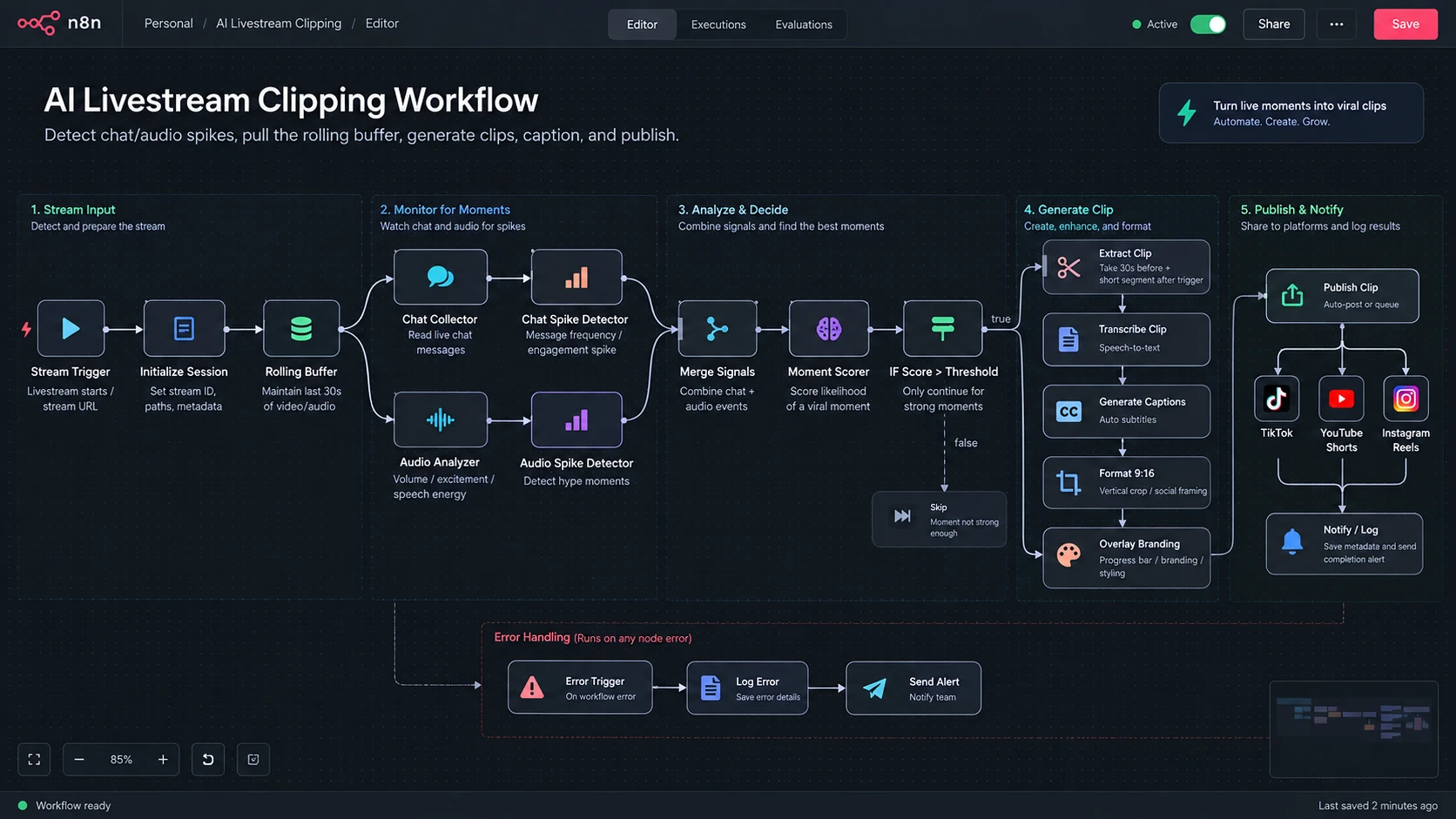
I tried chat bursts, audio spikes, exclamations and donations as signals that something interesting had happened. The design merged those signals into a score and used a threshold to decide whether to generate a clip.
This was the weak part. Detection was unreliable and often selected irrelevant footage. A spike in activity was not enough to tell whether a moment was worth watching.
Formatting the output
The output clips were fully formatted and looked good to me. The intended processing stages included transcription, subtitles, a vertical 9:16 frame and branding, with logging and error handling around the workflow.
The gallery image is an illustration of the intended architecture. It is not a running-workflow capture, and an actual output clip is not available on this page.
Posting and what I learned
The documented work includes a Hermes agent experiment using Android Debug Bridge for direct device control. Automatic posting remains unconfirmed. TikTok, YouTube Shorts and Instagram Reels were intended destinations; I do not have evidence here that all three operated as working integrations.
The useful next step is to evaluate selected moments against human choices before building more around posting. I learned that connecting the stages is only part of the problem: the selection decision has to produce something worth sharing.